
Learning about money, investing, and the stock market has become increasingly important. However, finding a suitable online course can be challenging, especially when different platforms promise to make financial education easier. This is one reason people are searching for FintechZoom.io courses to understand what the platform teaches, which programs are available, and whether its educational resources are worth considering.
FintechZoom.io presents itself as a financial education platform offering courses related to personal finance, stock market trading, and long-term investing. Its course descriptions target beginners as well as people who already have some financial knowledge and want to develop additional skills. However, understanding the advertised curriculum is only one part of choosing an educational program. Prospective learners should also examine instructor credentials, pricing, certification, and the organization’s identity before making a commitment.
In this guide, we explore the available courses, their advertised features, potential benefits, limitations, and important considerations. The goal is to help you understand what to expect and make a more informed decision before investing your time or money.
What Are FintechZoom.io Courses?
FintechZoom.io courses are online financial education programs advertised for people interested in improving their understanding of personal finance and financial markets.
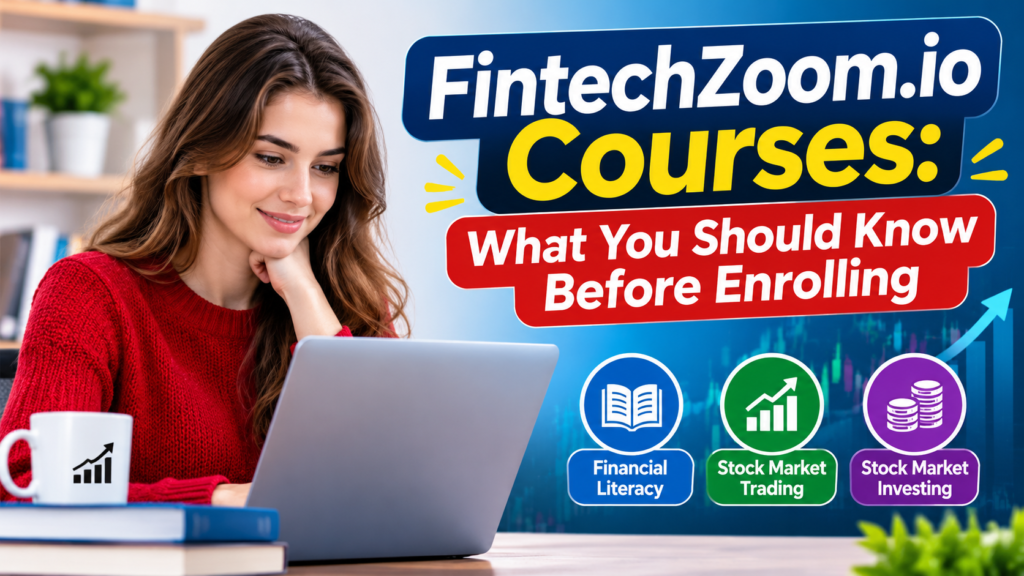
The platform’s public course catalogue identifies three main educational areas:
- Financial Literacy
- Stock Market Trading
- Stock Market Investing
Each program addresses a different learning objective. Financial literacy focuses on everyday money management, trading introduces shorter-term market activities, and investing explores longer-term approaches to building and managing a portfolio.
The platform describes its learning experience as flexible and self-paced. Its course pages also advertise educational materials, practical exercises, quizzes, and completion certificates.
An important distinction is that these are advertised features, not independent evidence of course quality or professional recognition. Learners should confirm the actual course contents and enrollment conditions before purchasing anything.
What Courses Does FintechZoom.io Offer?
Understanding the differences between the available programs can help you identify which subject is most relevant to your goals.
1. Financial Literacy Course
The Financial Literacy course is designed to introduce learners to essential personal finance concepts. It focuses on understanding income, expenses, savings, debt, and financial planning.
The advertised curriculum includes subjects such as:
- Creating and managing a personal budget.
- Developing consistent saving habits.
- Understanding credit and borrowing.
- Managing student loans and credit card debt.
- Learning the basics of taxes.
- Understanding interest rates.
- Exploring introductory investment concepts.
- Preparing for long-term financial goals.
For example, imagine someone who receives a monthly salary but struggles to save money. A financial literacy program can help that person categorize expenses, identify unnecessary spending, establish savings targets, and understand how debt affects financial stability.
One particularly useful skill is learning to distinguish between essential expenses, discretionary spending, and long-term financial commitments.
This course may be a reasonable starting point for students, working professionals, and people who want a stronger foundation in personal money management.
2. Stock Market Trading Course
The Stock Market Trading course focuses on understanding how traders participate in financial markets.
Unlike long-term investing, trading generally involves buying and selling financial assets over shorter periods. It requires an understanding of price movements, market behavior, risk, and trading decisions.
The advertised subject matter includes trading strategies and financial technology tools.
Important topics for anyone studying this area include:
- Understanding stock market terminology.
- Reading price charts.
- Learning about candlestick patterns.
- Exploring technical indicators.
- Understanding day trading and swing trading.
- Identifying potential entry and exit points.
- Learning stop-loss concepts.
- Managing trading risks.
Consider a beginner who notices that a company’s share price has been moving upward. Rather than purchasing immediately, a knowledgeable trader would examine the broader market, trading volume, price movements, and potential downside.
This illustrates why learning risk management is just as important as studying trading strategies.
Trading education should never be interpreted as a promise of profitable results. Even experienced traders experience losses, and short-term trading can expose beginners to substantial financial risk.
3. Stock Market Investing Course
The Stock Market Investing course is intended for people who want to understand how investments work and how portfolios can be developed over time.
Investing generally differs from active trading because investors often focus on longer-term financial objectives rather than frequent market transactions.
Relevant learning areas include:
- Understanding stocks and bonds.
- Exploring exchange-traded funds (ETFs).
- Learning portfolio diversification.
- Studying fundamental analysis.
- Understanding investment risk.
- Exploring asset allocation.
- Evaluating companies and financial performance.
- Developing long-term investment strategies.
For example, someone saving toward a financial goal several years away may want to understand the differences between individual stocks, diversified funds, and bonds.
Learning about diversification can help explain why concentrating all available money in one company creates a different risk profile from holding a mixture of assets.
This program may appeal to beginners who want to understand investment principles before making independent financial decisions.
How Do FintechZoom.io Courses Work?
The platform describes its courses as self-paced learning programs. This means learners can study according to their schedules instead of following a traditional classroom timetable.
The advertised learning features include several educational components.
On-Demand Video Lessons
Video lessons are intended to explain financial concepts in a structured format. Students can revisit explanations when they need additional clarification.
The published course descriptions advertise different video durations depending on the subject:
- Financial Literacy: approximately 3–5 hours.
- Stock Market Trading: approximately 4–6 hours.
- Stock Market Investing: approximately 7–8 hours.
These are advertised durations, not independently verified measures of the time needed to complete each course.
Worksheets and Learning Materials
The Financial Literacy and Investing course descriptions mention printable worksheets and practical learning materials.
These resources can be useful for applying concepts outside the classroom. For example, a budgeting worksheet can help someone calculate monthly income, fixed expenses, variable expenses, and savings.
Interactive Quizzes
Quizzes are advertised as a way to reinforce concepts and assess understanding.
A useful financial education assessment should test whether learners can apply knowledge rather than simply remember definitions.
For example, understanding diversification means being able to explain why holding several different investments can reduce dependence on one asset.
Certificates of Completion
The course pages advertise certificates after successful completion.
However, there is an important distinction between a certificate of completion and an accredited professional qualification.
A certificate issued by an online course provider does not automatically represent:
- A university degree.
- A government-recognized qualification.
- A professional securities license.
- Authorization to provide investment advice.
Anyone considering these courses for employment or career development should verify whether an employer or professional organization recognizes the certificate.
FintechZoom.io Courses: Benefits and Limitations
Every online education platform should be evaluated according to both its potential benefits and its limitations.
The following comparison separates the features advertised by the provider from the questions prospective learners should investigate.
| Potential benefits | Important limitations |
|---|---|
| Self-paced learning format | Instructor credentials are not clearly established |
| Several financial learning subjects | Public pricing requires confirmation |
| Advertised quizzes and worksheets | Independent course reviews are limited |
| Beginner-oriented subject descriptions | Accreditation is not established |
| Advertised completion certificates | Certificate recognition is unclear |
| Flexible study arrangements | Actual teaching quality is unverified |
Potential Benefits
1. Different learning objectives
The three advertised programs address personal finance, active trading, and long-term investing. This separation makes it easier to identify the subject that matches a learner’s interests.
2. Flexible learning
Self-paced education can be convenient for students and working professionals who cannot attend scheduled classes.
3. Practical financial concepts
Budgeting, debt management, portfolio diversification, and risk assessment are useful subjects beyond the stock market.
4. Structured subject coverage
A structured curriculum can help beginners understand financial concepts in a logical order instead of jumping between unrelated topics.
Important Limitations
The biggest limitation is the lack of independently established information about the course provider.
The public course descriptions do not clearly establish the identities and qualifications of individual instructors, external accreditation, or independently measured student outcomes.
Pricing and purchasing conditions should also be confirmed directly rather than assumed from descriptions published elsewhere.
These limitations do not prove that every lesson is poor quality. They mean that learners should avoid treating promotional descriptions as proof of educational quality.
Is FintechZoom.io Legitimate and Safe?
This is one of the most important questions to consider before enrolling.
FintechZoom.io publishes financial education pages and describes several courses. However, there is a significant issue involving its relationship with the better-known FintechZoom.com.
FintechZoom.com has publicly stated that fintechzoom.io is not affiliated with its organization and has identified the .io domain in a warning about websites impersonating its brand. This is a serious identity and trust concern. techindaily.com+1
The distinction matters because similar domain names do not establish common ownership.
A website can publish financial articles, offer educational programs, and have a professional-looking design without being officially connected to another organization using a similar name.
What Should You Verify Before Enrolling?
Before paying for any course, take the following precautions:
- Verify the organization: Identify the legal business operating the website and confirm its relationship, if any, with the organization whose name it uses.
- Check the instructors: Look for real names, professional biographies, relevant qualifications, and verifiable experience.
- Confirm the price: Request the complete price, including possible renewals, subscriptions, and additional charges.
- Read the refund policy: Obtain the actual written terms rather than relying on a general satisfaction guarantee.
- Examine the certificate: Confirm whether it is simply a completion document or carries recognition from an independent institution.
- Protect personal information: Avoid sharing banking passwords, brokerage login credentials, or unnecessary financial information.
For this particular platform, resolving the identity and affiliation issue should come before considering a purchase.
Is FintechZoom.io the Same as FintechZoom.com?
No. The two domain names should not be treated as interchangeable.
FintechZoom.com has explicitly disputed an affiliation with fintechzoom.io. Therefore, visitors should not assume that the .io courses are official educational products of FintechZoom.com. techindaily.com
This is especially important when searching for financial education because brand familiarity can influence purchasing decisions.
How to Choose the Right Financial Course
If your goal is to improve your financial knowledge, selecting a course should begin with identifying what you actually want to learn.
Here is a practical way to approach the decision.
Step 1: Identify Your Learning Goal
Ask yourself what financial problem you want to understand.
- Want to manage monthly expenses? Start with financial literacy.
- Want to understand stock market strategies? Study trading fundamentals.
- Want to build a long-term investment portfolio? Focus on investing principles.
Choosing based on your objective prevents you from spending time studying subjects that are not relevant to your needs.
Step 2: Examine the Curriculum
A good course should provide more than a list of attractive financial terms.
Look for:
- Clearly defined learning objectives.
- Detailed lesson descriptions.
- Logical progression from basic to advanced subjects.
- Practical examples.
- Knowledge assessments.
- Updated educational materials.
A course covering 30 topics is not necessarily better than one explaining 10 topics thoroughly.
Step 3: Evaluate the Teaching Quality
An instructor should be able to explain complicated subjects in straightforward language.
For financial education, practical examples are particularly important.
For example, a useful investing lesson should explain how diversification works, why fees matter, and how market volatility affects an investment portfolio.
Step 4: Compare the Total Cost
Do not select a course simply because it advertises lifetime access or a discount.
Compare the total cost with the educational value, available teaching support, curriculum depth, and recognition of the qualification.
Also consider whether similar introductory material is available through established free educational programs.
Step 5: Practice Before Making Financial Decisions
Learning a trading strategy does not mean you should immediately use real money.
Beginners can first practice interpreting charts, reviewing hypothetical portfolios, and understanding different market scenarios.
This approach helps separate educational progress from financial risk.
Three Important Lessons for New Financial Learners
Beyond choosing a course, there are several principles worth understanding before entering the world of investing and trading.
1. Financial Literacy Should Come Before Trading
Many beginners become interested in trading because they see discussions about stock prices and potential profits.
However, understanding budgeting, debt, savings, interest, and emergency funds should come first.
Someone who does not understand their personal financial position may find it difficult to manage investment risk responsibly.
2. Understanding Risk Is More Valuable Than Chasing Returns
An investment course should explain what can go wrong, not simply describe potential profits.
For instance, investing a large percentage of available money in one company creates concentration risk.
Understanding diversification, investment time horizons, and potential losses helps learners make more balanced decisions.
3. Course Completion Does Not Equal Financial Expertise
Finishing an online course is a learning milestone, not proof of professional competence.
A learner may understand financial terminology after several hours of lessons but still need substantial practice to evaluate companies, interpret economic conditions, or manage a portfolio.
The better measure of progress is whether you can independently explain financial concepts and recognize the limitations of your own knowledge.
Common Mistakes to Avoid When Choosing Online Finance Courses
New learners sometimes make purchasing decisions based on marketing instead of educational value.
Avoid these common mistakes:
- Trusting a familiar brand name: Similar domain names do not prove common ownership.
- Expecting guaranteed profits: No legitimate educational course can guarantee investment returns.
- Ignoring instructor qualifications: Teaching experience and professional credibility matter.
- Assuming certificates are accredited: Always verify external recognition.
- Overlooking recurring charges: Check subscription and renewal conditions.
- Confusing trading with investing: They have different objectives, time horizons, and risk profiles.
- Paying before checking refund terms: Understand the conditions before completing a purchase.
A careful evaluation can prevent unnecessary expenses and help you identify more reliable educational opportunities.
FAQs
1. What courses are available on FintechZoom.io?
FintechZoom.io advertises three main programs: Financial Literacy, Stock Market Trading, and Stock Market Investing. Each program focuses on a different financial subject, from everyday money management to financial market analysis. The courses are presented as online learning options for beginners and other interested learners.
2. Are FintechZoom.io courses suitable for beginners?
The courses are marketed toward beginners and people with existing financial knowledge. The Financial Literacy program is particularly relevant to those starting with budgeting, saving, and debt management. However, beginners should independently verify the course provider and teaching quality before purchasing.
3. How much do FintechZoom.io courses cost?
A consistently verified public price for the courses could not be established from the available course information. Prices mentioned by third-party websites should not automatically be considered accurate. Check the actual checkout price, subscription conditions, and possible additional charges before making a payment.
4. Do FintechZoom.io courses provide certificates?
The platform’s course descriptions advertise certificates of completion. However, this does not establish that the certificates are accredited or recognized by universities, employers, or financial regulators. Anyone seeking a professional qualification should verify recognition independently.
5. Is FintechZoom.io affiliated with FintechZoom.com?
FintechZoom.com explicitly states that it is not affiliated with fintechzoom.io. Consequently, users should not assume that the courses are official products of FintechZoom.com. This distinction is particularly important when evaluating the provider’s identity and deciding whether to share payment information.
6. Can FintechZoom.io courses help someone become a successful trader?
Financial education can improve understanding of market concepts, technical analysis, and risk management. However, completing a course does not guarantee profitable trading. Successful decision-making also requires experience, discipline, market awareness, and an understanding of potential losses.
Conclusion
FintechZoom.io courses cover three important areas of financial education: personal finance, stock market trading, and long-term investing. Their advertised curriculum includes subjects that can help learners understand budgeting, financial markets, investment strategies, and risk management.
For beginners, the distinction between financial literacy, trading, and investing is particularly valuable because each subject requires a different approach and set of skills.
However, the most important consideration is the platform’s credibility. FintechZoom.com has publicly disputed its affiliation with fintechzoom.io, making independent verification essential before enrolling or sharing sensitive information. Instructor credentials, pricing, refund conditions, and certificate recognition also deserve careful attention.
Ultimately, good financial education starts with informed decisions. Before paying for any online finance program, examine who operates it, what it actually teaches, and whether its educational value justifies the cost. Learning about money is worthwhile, but choosing a trustworthy source is the first step toward making that knowledge useful.